


- US agreements increasingly link security, health assistance and investment to strategic access, domestic contributions and compliance obligations.
- African governments have responded differently, with some challenging, rejecting or suspending agreements that threaten policy independence.
- Collective African bargaining, stronger oversight and transparent agreements could help governments secure better terms in dealings with Washington.
The most important change in US policy towards Africa under the second Trump administration may not be the abandonment of multilateralism. It is something more consequential: the growing conversion of cooperation into a series of bargains in which technical assistance or aid, security partnerships, mineral access and migration management are increasingly treated as instruments of strategic exchange.
This does not mean that transactional foreign policy is new. The United States has long used aid to advance diplomatic, commercial and security interests. What is different is the degree to which these interests are now being made explicit and embedded in bilateral arrangements. The emerging pattern is visible in two otherwise very different areas: the Washington Accords and the America First Global Health Strategy (AFGHS).
Critical minerals and the Washington Accords
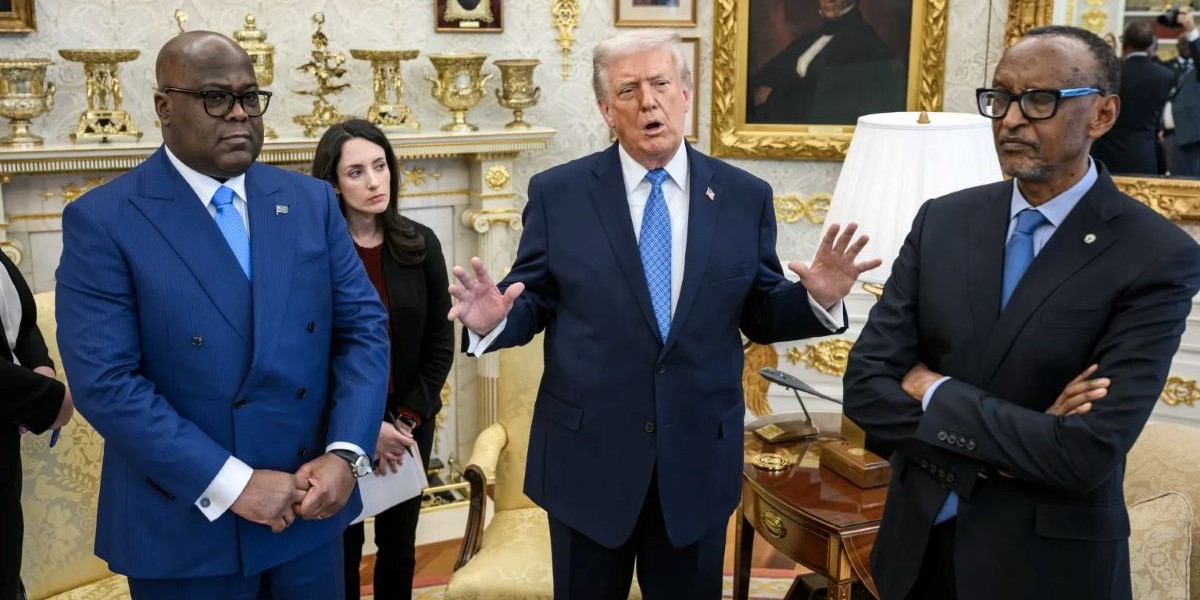
The Washington framework illustrates the logic particularly clearly. The US–DRC Strategic Partnership Agreement links security cooperation to critical minerals, infrastructure and regulatory reform. Its provisions establish a Strategic Asset Reserve, create a Joint Steering Committee to oversee implementation and compliance, and give US persons preferential access to designated strategic opportunities.
Dispute resolution is placed outside ordinary DRC domestic judicial processes, while termination requires five years’ written notice. The result is not simply a peace agreement accompanied by investment. It is an institutional arrangement in which strategic access, regulatory adjustment, monitoring and exit are legally organised around a bilateral bargain.
As of September 2026, the DRC had approved a task force to accelerate implementation, after the deal had already delivered a US-backed mining investment through Virtus Minerals and expanded copper offtake arrangements between state miner Gecamines and traders Mercuria and Glencore.
Health funding and the price of cooperation
Health policy reveals a parallel, though not identical, structure. Following Washington’s exit from the World Health Organisation, the AFGHS has shifted from broad multilateral health cooperation towards bilateral agreements centred on preparedness, surveillance, data sharing, co-investment and measurable deliverables.
Twenty-four African bilateral health memoranda of understanding provide the documentary basis for examining this shift. Their significance lies less in the headline value of individual funding packages than in how funding is linked to obligations, monitoring arrangements and domestic contributions.
By July 2026, 34 countries had signed bilateral health agreements, 25 in Africa, totalling about USD 20.6 billion, including USD 12.8 billion in US assistance and USD 7.8 billion in country co-investment.
Who carries the risks of these agreements?
This matters because contractual design determines who bears the risks when cooperation becomes difficult. A country may receive infrastructure, health financing or diplomatic support while simultaneously accepting obligations that constrain its room for manoeuvre. Co-financing can shift fiscal risk to governments already facing severe budgetary pressures.
Data-sharing provisions can integrate national biological and epidemiological resources into international systems, whose downstream benefits are not necessarily distributed equally. Preferential mineral access can create investment opportunities while giving the stronger negotiating party greater influence over how those opportunities are allocated.
African governments are not merely passive participants
It would be a mistake to portray African governments simply as passive recipients of American demands. African agency remains central to the outcome of these bargains. Governments may accept an agreement because it provides urgently needed financing, infrastructure, security assistance or diplomatic leverage. Others may resist when the domestic political or sovereignty costs become too high.
Kenya has used legal or legislative institutions to contest aspects of US health cooperation, while Zimbabwe rejected a proposed health arrangement and Zambia suspended a major package. South Africa, meanwhile, has sought to absorb some costs domestically to preserve greater policy independence.
This variation is important. Transactionalism does not yield identical outcomes because bargaining power is never exercised in a vacuum. Domestic institutions, fiscal capacity and political legitimacy shape how governments respond. The real danger is therefore not that every African state will accept every American demand, but that fragmented bilateral bargaining can prevent African states from negotiating collectively. A government facing a pressing fiscal or security need may rationally accept terms that would be less attractive if negotiated collectively with other African governments.
Migration deals and the transfer of responsibility
Migration demonstrates how far this thinking may extend. The use of third-country deportation arrangements shifts the costs of US immigration enforcement onto African states. Countries like Eswatini and Rwanda may receive financial or diplomatic concessions while assuming responsibility for people who are not their citizens.
The evidence shows a broader environment in which bilateral relationships can contain several simultaneous bargains, governed by similar principles of conditionality, discretion and unequal burden-sharing.
By the latter half of 2026, Burundi had agreed to accept third-country deportees, joining at least seven other African nations, while rights groups warned that such transfers could circumvent the legal protections migrants obtain in US immigration courts.
What distinguishes ‘America First’?
That distinction is significant. The argument is not that Washington has suddenly discovered conditionality, nor that every bilateral agreement is coercive.
Earlier American administrations also used conditional aid, performance requirements and withdrawal mechanisms. The difference lies in the recombination and institutionalisation of these instruments under ‘America First’. As the article’s comparative analysis shows, the transformation is less about bilateralism itself than about how bilateral agreements relocate conditionality into arrangements with greater executive discretion.
This raises a larger question for Africa: should individual governments continue negotiating these bargains separately, or develop stronger collective mechanisms for doing so?
Collective bargaining as a strategic response
The answer need not be ideological. Collective bargaining is not synonymous with rejecting American engagement. On the contrary, African governments can use collective institutions to negotiate better terms for cooperation with the United States, China, Europe and other external partners.
The African Vaccine Acquisition Task Team demonstrated during COVID-19 that pooled demand can strengthen negotiating capacity. The same principle could apply to health technology, data governance, critical minerals, infrastructure and migration arrangements.
The objective should therefore be neither to romanticise multilateralism nor to condemn bilateral agreements. It should be to ensure that bilateralism does not become a mechanism by which African states compete against one another for increasingly conditional external resources.
Stronger parliamentary scrutiny, judicial review, transparent publication of agreements and regional negotiating platforms would not prevent governments from making strategic deals. They would improve their ability to do so on terms that protect domestic policy space.
Africa must decide how it bargains
America First may ultimately prove less durable than its advocates expect: its implementation remains politically and legally contested. But still, the institutional tendency is already significant. Cooperation is increasingly structured around measurable returns, strategic access, performance, monitoring and exit.
The question Africa faces, then, is not whether to bargain with Washington. It is whether to continue bargaining 54 times, country by country, or to learn to bargain with greater collective leverage. The former maximises immediate national discretion but can deepen structural asymmetry. The latter would not eliminate unequal power, but it could change the terms on which that power is exercised.
The age of the bargain is not necessarily a problem. The problem arises when every bargain is negotiated alone.
Siya yi banga le economy!
Get your news on the go. Click here to follow the Conviction WhatsApp channel.
The opinions expressed in this article are solely those of the author and do not necessarily reflect the views of Conviction.co.za
