



- Creditors whose claims arise after business rescue begins have no vote on adopting a rescue plan, the Constitutional Court ruled.
- Qualifying post-commencement claims may receive preferential payment under section 135 of the Companies Act, but this is neither security over an asset nor a guarantee of recovery.
- Suppliers and other creditors must establish when their claims arose and assess the payment risks before extending further credit to a company in business rescue.
AT A GLANCE
| THE RULING Creditors whose claims arise after business rescue begins have no vote on the adoption of the plan. | WHAT REMAINS Qualifying claims may carry a statutory payment preference, which is not security and not a guarantee. | WHAT IT MEANS Further credit to a company in rescue is a decision about payment risk. A vote does not come with it. |
The decision facing a supplier
Consider a hypothetical supplier. Its customer has entered business rescue, and the business rescue practitioner asks it to continue delivering on credit. The supplier is already owed for earlier deliveries, and every further delivery adds to its exposure. A natural question follows: if it keeps supplying, will the new debt give it a vote on the rescue plan?
The Constitutional Court answered that question on 7 October 2026. A unanimous Court declared, in Salungano Group Ltd v Mashwayi Projects (Pty) Ltd and Others; Ndalamo Coal (Pty) Ltd v Mashwayi Projects (Pty) Ltd and Others [2026] ZACC 38, that the Companies Act 71 of 2008 does not permit post-commencement creditors to vote on the adoption of a business rescue plan. Being owed money by a company in business rescue and being entitled to vote on its plan are separate questions, each governed by its own rules.
What the rescue plan decides
Business rescue places a financially distressed company under the temporary supervision of a business rescue practitioner, with a temporary moratorium on legal proceedings against it, subject to limited exceptions. The aim is to restructure the company so that it can continue on a solvent basis or, if that is not possible, to achieve a better return for its creditors or shareholders than an immediate liquidation would.
The plan is where the important decisions are made. It may provide for the business to continue or to be sold, how much of the existing debt will be paid and when, whether any debt is released or converted to shares, how existing agreements are to be treated, and the order in which the available proceeds will be paid out.
| 75% | A plan is approved if it is supported by the holders of more than 75% of the creditors’ voting interests that were voted, including at least 50% of the independent creditors’ voting interests voted, if any. An adopted plan binds the company and its creditors, including those who voted against it or did not attend the meeting. That is why the vote matters. |
What the Constitutional Court decided
The case concerned Arnot Opco, which operates a coal mine in Middelburg and entered business rescue in October 2022. Creditors voted on a plan in July 2023. The practitioner first reported that a sale of the business as a going concern had the required support, but later reported irregularities in the count and concluded that the 75% threshold had not been met.
The courts below disagreed on who was entitled to vote. The High Court held that only creditors whose claims existed when business rescue began could vote, and found that the plan had been adopted. The Supreme Court of Appeal held on 29 January 2025 that post-commencement creditors may vote, and ordered a fresh vote. The Constitutional Court set that decision aside on the voting question.
The court did not, however, simply restore the plan on the facts. It found that the irregularities in the count affected the legitimacy of the plan’s adoption, declared that the plan had not attained the required support, and sent the matter back to the practitioner for a fresh vote, in which only those eligible may vote.
HOW THE CASE UNFOLDED
| Oct 2022 Arnot Opco enters business rescue | Jul 2023 Creditors vote; the practitioner later reports irregularities in the count | High Court Only pre-commencement creditors may vote; plan adopted | Jan 2025 Supreme Court of Appeal: post-commencement creditors may vote | 7 Oct 2026 Constitutional Court: no vote; fresh vote ordered |
Why the Court drew the distinction
The court’s reasoning can be summarised in four steps.
| 01 The plan identifies creditors at commencement The Act requires the plan to list the company’s creditors as they stood when business rescue began. The court read this as fixing the body of creditors who decide the plan. | 02 Voting needs an identifiable body of eligible claims Notice of the meeting, including a summary of voting rights, must be given in advance, and votes follow claims proved and admitted by the practitioner. The court reasoned that a pool of claims that keeps growing and shrinking during the rescue could not be fixed in that way. |
| 03 Post-commencement claims receive a different form of protection The Act gives qualifying claims a statutory payment preference instead of a vote, which the court described as a deliberate choice of “security rather than governance power”. Employees, for example, vote only in respect of amounts that fell due to them before the rescue, and later amounts are protected by the preference. | 04 The Court was concerned about outside influence Allowing later creditors to vote could let parties with financial muscle block an appropriate plan and push a company into liquidation that could have been avoided. |
“Security rather than governance power”
The Constitutional Court, on why the Act gives post-commencement finance a preference instead of a vote
What protection remains without a vote
The protection lies in Section 135 of the Act, which ranks qualifying post-commencement claims after the practitioner’s remuneration and expenses and the other costs of the business rescue proceedings. Amounts relating to employment that fall due during the rescue rank, within that scheme, ahead of other post-commencement financing and all unsecured claims.
Since 27 December 2024, unpaid amounts due to a landlord for public utility charges, such as rates, electricity and water, that the landlord paid to third parties during the rescue have also been treated as post-commencement finance. In the words of the Act, these rank below employees’ post-commencement claims ‘but ahead of all the secured and unsecured claims against the company’. Unpaid rent does not qualify. The courts have yet to test how this ranking applies in practice.
Other financing obtained during the rescue ranks ahead of unsecured claims, in the order in which it was incurred. The court also gave amounts payable to landlords and suppliers for continuing the business as examples of costs of the rescue. Whether a particular supplier’s claim qualifies, and where it ranks, depends on its facts. The preference survives if the rescue fails and the company is liquidated, except against the costs of the liquidation.
The preference has limits. It is a place in the order of payment, not security over an asset, unless the finance has been secured over an asset of the company that was not already encumbered. It is not a guarantee of recovery either, because payment depends on the funds available.
| A STATUTORY PREFERENCE IS | A STATUTORY PREFERENCE IS NOT |
| ● A place in the order of payment ● Limited to qualifying claims, depending on their facts ● Kept if the rescue fails and the company is liquidated, except against the costs of the liquidation | ● Security over an asset, unless the finance was secured over an unencumbered asset ● A guarantee of recovery, because payment depends on the funds available ● A vote on the plan |
The Constitutional Court reasoned that the statutory scheme contemplates a preferent claim that stands regardless of the plan. The High Court in KwaZulu-Natal separately held in 2025 that a plan may not compromise a post-commencement claim unless the creditor agrees to it (JBSA Props (Pty) Ltd and Another v Commissioner for the South African Revenue Service and Others [2025] ZAKZPHC 3).
The court also observed that those who provide finance during a rescue typically protect their interests through the terms of their funding, for example by making it conditional on the approval of a plan they find acceptable. A supplier can, in my view, apply the same thinking when deciding the terms on which it continues to deliver, even though the court’s observation was made about funders.
TWO SEPARATE QUESTIONS ABOUT EVERY CLAIM
| Does it carry a vote on the plan? | How is it protected for payment? | |
| A claim that existed when business rescue began | YES If the claim is proved and admitted | Under the plan Payment is dealt with by the adopted plan |
| Any claim that arises during the rescue | NO No vote on the plan | Possibly a preference Some qualify for a statutory payment preference, which ranks the claim without securing it or guaranteeing payment |
| A creditor may hold claims of both kinds. Each claim is assessed on its own facts. | A creditor may hold claims of both kinds. Each claim is assessed on its own facts. | A creditor may hold claims of both kinds. Each claim is assessed on its own facts. |
What to check before extending further credit
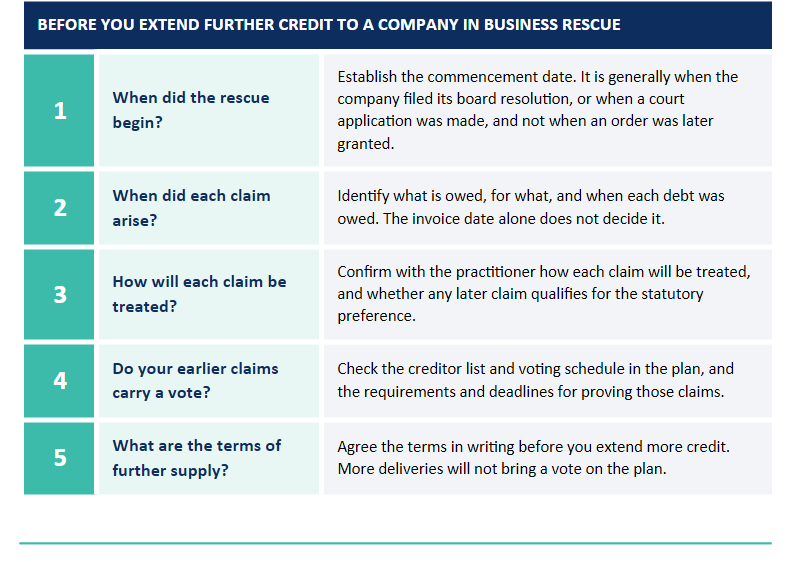
Two dates matter. The first is when business rescue began. That is generally when the company files its board resolution with the Companies and Intellectual Property Commission or, where an affected person applies to court, when that application is made, which, on the approach of the Supreme Court of Appeal, requires the application to be issued, served by the sheriff on the company and the Commission, and notified to affected persons.
The date on which the court later grants the order is not the commencement date in that case. Where a court places a company in business rescue during liquidation or enforcement proceedings, the rescue begins with the court’s order.
The second is when each claim arose. The Supreme Court of Appeal has held, in the context of business rescue, that the question is when a debt is owed, not when it is quantified, invoiced or payable (Henque 3935 CC t/a PQ Clothing Outlet v Commissioner for the South African Revenue Service [2025] ZASCA 56).
Tax for a period that ended before the rescue is a pre-commencement debt even if it is assessed later, and VAT is owed when the supply is made. Employment amounts are an exception: the Act asks when they became due and payable. These principles were developed in relation to the enforcement of debts rather than voting, so the position of each claim should be confirmed with the practitioner.
The practical steps are set out in the summary at the end of this article.
| TWO QUESTIONS THE COURT LEFT OPEN The Court expressly stated that employees vote only in respect of their pre-commencement claims, but it did not decide the position of other creditors who hold claims from both before and after commencement, although its treatment of employees is the closest guidance. It also did not decide whether a claim that existed at commencement, but was bought from another creditor after the rescue began, carries a vote. Ordinary principles of cession point one way and the concern about speculators another, so a buyer of claims should not assume that the claim carries a vote. |
Back to the supplier
Continuing to deliver is, for our supplier, a decision about payment risk and the terms that govern it. Its new deliveries will not carry a vote; any vote it has will rest on its earlier claims. A vote on the plan does not come with further exposure, and the supplier should decide on that basis.
This article states the position as at 21 October 2026.
More about Vezi de Beer Inc.
Vezi de Beer Inc. is a South African law firm practising in commercial and banking litigation, insolvency and business rescue, debt recovery, conveyancing and deceased estates. Its practitioners serve on the Master’s panels as liquidators, trustees and curators, and are members of the South African Restructuring and Insolvency Practitioners Association.
Get your news on the go. Click here to follow the Conviction WhatsApp channel.
This article provides general legal information and does not constitute financial or legal advice. Readers should obtain advice specific to their circumstances. If you need to consult or have a question on these matters, email expert@conviction.co.za
