


- Claus Schroeder disappeared from Owvanuk Farm near Thornhill on 14 August 2009 after leaving with Jens Leunberg.
- Blood containing Schroeder’s DNA was found in a Volkswagen Kombi that had been cleaned with bleach. Leunberg gave several conflicting stories about what took place.
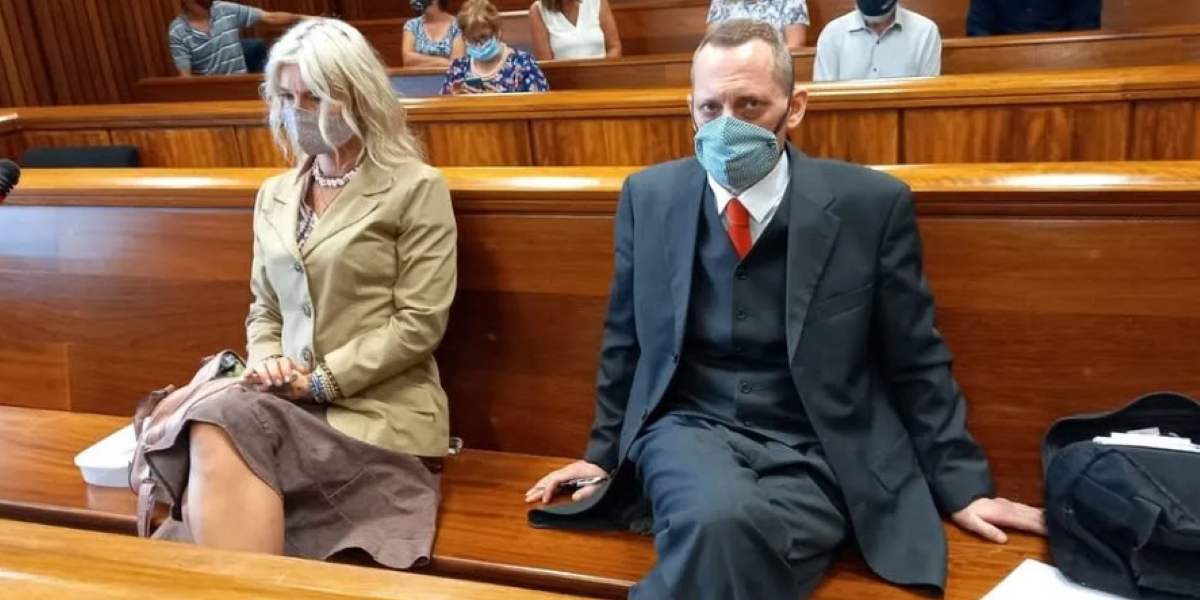
- The High Court in Makhanda upheld Leunberg’s murder conviction and 25-year sentence, but overturned Kristina Adler’s conviction for being an accessory after the murder.
The disappearance of a businessman from an Eastern Cape farm, a vehicle containing his blood and a series of fabricated stories about his whereabouts formed the central evidence in a murder appeal involving two German nationals.
Claus Schroeder and his wife, Tanja, had moved from Germany to South Africa in 2000 and settled in Jeffreys Bay, where they established a furniture business and acquired several properties, including Owvanuk Farm near Thornhill.
Jens Leunberg and Kristina Adler arrived in South Africa in 2007 and presented themselves as wealthy businesspeople. They initially rented accommodation on the farm before expressing an interest in buying it. Adler registered Thornhill Ubuntu Tourism Activities CC, which was presented to the Department of Home Affairs as the vehicle for their proposed tourism business.
In October 2007, Ubuntu Tourism agreed to buy Owvanuk Farm for R8.5 million. The buyers never provided the required proof of financing. Later, the Schroeders’ attorneys received a fake document claiming to be from a German bank. The couple were allowed to move in during January 2008, but they stopped paying rent by May and did not pay for electricity or water.
Leunberg kept telling the Schroeders that his money in Germany was frozen by tax authorities but would be released soon. He also talked about a European Union investment in tourism projects and used these stories to convince the Schroeders to sign more agreements.
In April 2009, a new sale was agreed for Owvanuk Farm, three other properties, and movable assets like a Hummer H3 and a Volkswagen Kombi. The price was now R60.1 million. Leunberg also arranged accommodation for 56 so-called European Union inspectors, who were supposed to visit the properties. They never showed up, and the Schroeders were left with large bills for the unused accommodation.
There were even more agreements after that, and the price was eventually dropped to R56.1 million. The deadline to pay was extended to 3 August 2009, but no money was ever paid. Leunberg kept promising the Schroeders that millions were about to arrive, even claiming that R42 million had been paid into his Swiss bank account.
By August 2009, the financial pressure was intense. On 13 August, Schroeder told his wife that he would cancel the deals if Leunberg did not pay R350 000 by the next day. Leunberg then asked him to travel to Port Elizabeth to meet some supposed Arab buyers. That meeting never happened, and Schroeder came home late that night.
Schroeder disappears
On 14 August 2009, Schroeder drove his Hummer to Owvanuk Farm. Later, he walked toward the stables with Adler. Leunberg showed up in a borrowed bakkie, and Schroeder got in with him. They drove off into the bush. That was the last time anyone saw or heard from Schroeder.
Afterwards, Leunberg gave Tanja a series of different stories. First, he said Schroeder went to meet a man named Mohammed Khan. Then, he claimed Schroeder had travelled to a farm in the Karoo. Later, he suggested Schroeder had run off with a woman called Belinda. Investigators could not find any phone record of this supposed call from Belinda.
Farm workers put Leunberg with Schroeder just before he disappeared and described suspicious behaviour after that. One worker saw Leunberg coming out of the bush and washing his hands at the outside shower. Another worker testified about Leunberg and Adler arguing over the missing Hummer keys.
A worker also saw Leunberg washing the Kombi and throwing away two blue refuse bags. When Tanja later checked the vehicle, she noticed that some areas seemed to be carefully cleaned. A former police officer spotted a dark stain on the rear floor, and a police sniffer dog indicated something at that spot.
Forensic tests showed that the stain was blood matching Schroeder’s DNA. Investigators also found signs that bleach had been used to scrub the vehicle. Police and searchers combed the farm and surrounding areas but never found Schroeder’s body. Still, the appeal judges found that, when all the evidence was taken together, it proved Schroeder had been killed and that Leunberg was responsible.
The judges agreed that the evidence suggested Schroeder’s body was carried in the Kombi and disposed of somewhere, although they did not need to decide exactly where or when. While they accepted some criticism of cellphone-tracking evidence about one journey, this did not weaken the bigger case against Leunberg.
Adler’s role in the disappearance
The appeal also looked at Adler’s conviction for being an accessory after the murder. The trial court found that Leunberg told her about the killing and believed that her actions afterwards were meant to protect him.
But the appellate judges decided the evidence did not show that Adler actually knew Schroeder had been killed. The argument overheard by a domestic worker was only about the missing Hummer keys, and other evidence was unreliable. The State also failed to prove Adler knew the Kombi had been cleaned with bleach or that she tried to hide what happened to Schroeder.
So, her conviction for being an accessory after the murder was thrown out. However, Adler’s conviction for immigration fraud was upheld. The judges found that she had knowingly signed an application to Home Affairs that gave a false picture of the business and promised to employ five South Africans. When asked whose business it was, she replied, “My own company, my own business.”
Her conviction for property fraud was also set aside. While she took part in the deals and joined Leunberg in telling the Schroeders that the money had arrived, the State could not prove she knew the promise was false or that she intended to trick them.
Leunberg’s murder sentence upheld
Leunberg tried to argue that the murder was not planned, but the appeal judges said there was no reason to overturn the trial court’s findings. They pointed out that he was the last person seen with Schroeder and never explained what happened to him.
The judgment, delivered by Judge JW Eksteen and Judge A Govindjee, with Acting Judge A Bodlani agreeing, called Leunberg’s evidence a “pack of lies”. The appeal against Leunberg’s convictions and sentences was dismissed, so his 25-year sentence for murder and the two 13-year sentences for fraud stand.
Adler’s convictions and sentences for being an accessory to murder and for property fraud were set aside. She was still found guilty of immigration fraud, but her 10-year sentence was reduced to three years in prison, backdated to when she was first sentenced.
Get your news on the go. Click here to follow the Conviction WhatsApp channel.
