


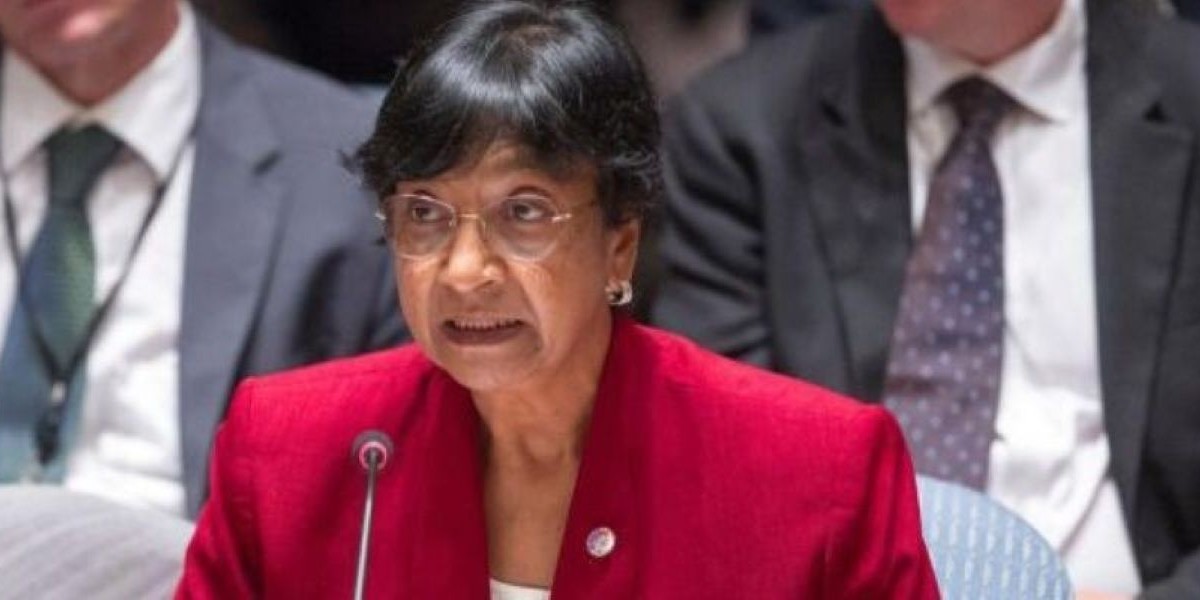
- Pillay challenged apartheid-era state violence, defended political prisoners and helped advance equality and human rights in South Africa.
- Her work at the Rwanda tribunal established that rape and sexual violence can constitute acts of genocide, strengthening accountability under international criminal law.
- Her leadership of the UN Commission of Inquiry on the Occupied Palestinian Territory brought renewed scrutiny to genocide allegations in Gaza and the failure of governments to act on evidence of mass atrocities.
The award of the 2026 Nobel Peace Prize to Judge Navi Pillay is a recognition not merely of an individual career, but of a rare tradition of legal practice. The Norwegian Nobel Committee honoured her “for her efforts to promote peace and international law,” noting that her work has “significantly enlarg[ed] the scope and impact of international law.”
From the standpoint of the oppressed, however, the significance of Judge Pillay’s career lies less in the institutional accolades than in the political choice that has defined it. She belongs to that small, courageous minority of jurists who have thrown their lot in with the oppressed and used the legal profession to advance human rights, social justice, and the causes of the oppressed.
She is not a neutral arbiter. At best, litigation can be used to defend the oppressed against the arbitrariness and violence of the state. Judge Pillay’s career illustrates both the possibilities and the limits of that defensive use of law.
The apartheid years: Defending the defenceless against state violence
Judge Pillay’s legal career began under apartheid in conditions of racial and gender exclusion that barred her from the very institutions she would later lead. In 1967, she became the first woman to establish a law practice in Natal Province. For nearly three decades, she defended opponents of the apartheid regime, exposed torture, and secured key rights for political prisoners on Robben Island, including the right to legal representation.
In 1971, she represented members of the Unity Movement charged under the Terrorism Act, and her defence team exposed the use of torture during interrogations. She represented her own husband when the Security Police detained him. In the mid-1970s, she defended Black Consciousness Movement activists, including Saths Cooper and Strini Moodley. Her work attracted the attention of apartheid security authorities, and she was denied a passport for years.
This was not the career of a jurist who saw law as merely a technical administration above social conflict. It was the practice of a lawyer who understood that under conditions of national oppression and class rule, the courtroom can still be used as one of the spaces where the state’s arbitrary power can be contested, although unevenly. The task of a people’s lawyer is to use every procedural opening, every evidentiary rule, and every right, however limited, to defend those whom the state had marked for oppression and marginalisation.
Rwanda: A jurisprudence against impunity in war-time GBV
Judge Pillay’s appointment to the International Criminal Tribunal for Rwanda in 1995, and her election as its President in 1999, marked a decisive shift from national to international terrain. She was the only female judge on the tribunal at the time, and she used that position to compel prosecutors to investigate gender crimes that had been systematically ignored.
Her most enduring contribution came in the Akayesu case, the first conviction for genocide by an international tribunal. The judgment established that rape and sexual violence could constitute acts of genocide when committed with the intention of destroying a protected group. After the judgment, Judge Pillay stated, “From time immemorial, rape has been regarded as spoils of war. Now it will be considered a war crime. We want to send out a strong message that rape is no longer a trophy of war.”
That formulation, the transformation of women’s bodies from “spoils” to subjects of legal protection, represented a genuine advance in international criminal law. It was a juridical rupture with a centuries-old tradition that had treated sexual violence in conflict as an inevitable by-product of war rather than a weapon of genocide. Judge Pillay’s jurisprudence here was not merely an academic contribution. It was political in the best sense. It named a harm that power had preferred to leave unnamed.
Palestine: Calling genocide what it is under pressure and imperialist bullying
The most recent and most contested chapter of Judge Pillay’s career has been her chairing of the UN Independent International Commission of Inquiry on the Occupied Palestinian Territory from 2021 to 2025. In September 2025, the Commission concluded that Israeli authorities and security forces had committed four of the five acts defined as genocide under the 1948 Genocide Convention. These included killing members of a protected group, causing serious bodily or mental harm, deliberately inflicting conditions calculated to bring about physical destruction, and imposing measures intended to prevent births.
The Commission further found that Prime Minister Benjamin Netanyahu, President Isaac Herzog, and former Defence Minister Yoav Gallant had incited genocide, and that Israeli authorities had failed to punish them. Judge Pillay stated that the evidence showed “an intent to destroy the Palestinians in Gaza” and directed criticism at governments continuing to arm or politically support Israel. She said, “When clear signs and evidence of genocide emerge, the absence of action to stop it amounts to complicity.”
This work has been dismissed by Israel as “scandalous” and attacked by apologists for colonial violence. From the standpoint of the oppressed, what is significant is precisely the political courage required to name genocide when naming it carries material diplomatic and professional costs. The Commission’s findings are not binding judicial rulings, and they do not speak for the UN as a whole. They represent an act of juridical truth-telling that exposes the gap between the law’s universalist rhetoric and the imperialist realities it serves.
Contributions to human rights jurisprudence
Judge Pillay’s contributions extend beyond the courtroom. As a member of the Women’s National Coalition in South Africa, she contributed to the inclusion of the equality clause in the post-apartheid Constitution, which prohibits discrimination on grounds of race, gender, religion, and sexual orientation. She co-founded Equality Now, an international women’s rights organisation, and has been involved in work on children’s rights, detainees, victims of torture, domestic violence, and economic, social, and cultural rights.
She served as a judge on the International Criminal Court from 2003 to 2008 and as UN High Commissioner for Human Rights from 2008 to 2014. She is currently an ad hoc judge at the International Court of Justice in The Gambia’s genocide case against Myanmar.
A jurist on the side of the oppressed
The Nobel Committee’s citation emphasises that Judge Pillay’s career demonstrates how international law can provide accountability for victims and offer an alternative to violence at a time when courts and legal institutions were facing growing political attacks. This is true as far as it goes. However, a reading from the standpoint of the oppressed suggests something more. Her significance lies in her refusal to accept the law as it is, and her insistence that the law’s own proclaimed principles can be turned against the state when it acts arbitrarily and violently.
Her jurisprudence and legal practice never feigned neutrality. She is a jurist of the oppressed. In a profession that generally produces technicians of power and professional administrators of the oppressive legal order, her career is a reminder that litigation can still be used, within the extremely narrow limits of the capitalist state and imperialist architecture, to defend the oppressed against the arbitrariness and violence of oppressive states and powerful actors.
The Nobel Prize is a recognition of that defence. It is for the rest of us, lawyers, scholars, and activists, to take inspiration from her illustrious work and continue the work of defending the most marginalised and their rights.
This is all the more important now than at any time in recent memory. The rights conquered in the bloody struggles and revolutions of the past are under relentless attack here in South Africa and globally.
The global drift towards authoritarian right-wing populism and the surge of embryonic fascism mean that to be a lawyer and jurist of Judge Pillay’s calibre requires a determination to swim against the stream of reaction against the rights of migrants, women, gender and racial minorities, workers, and every marginalised section of the working classes whose rights are under a barrage of right-wing populist attacks today.
Get your news on the go. Click here to follow the Conviction WhatsApp channel.
The opinions expressed in this article are solely those of the author and do not necessarily reflect the views of Unisa or Conviction.co.za
