


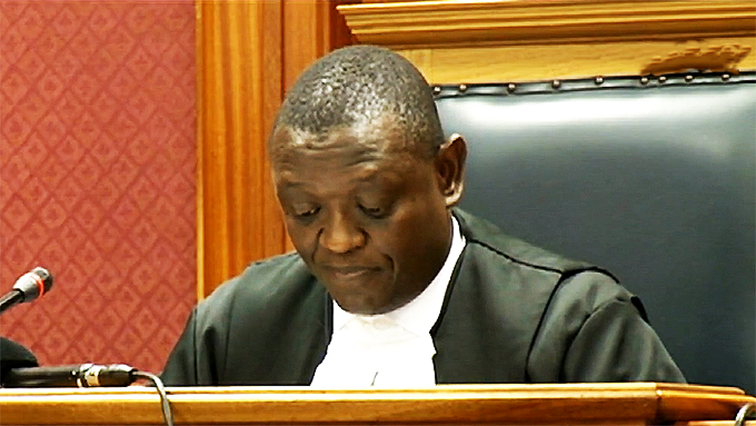
- Judge Thulare must vacate the State-owned house within one month and apologise to the South African public.
- He must repay the difference between the market rental value and the rent he paid since his judicial appointment in 2022, with interest.
- The Judicial Conduct Committee found that his continued occupation of the property undermined public confidence in the Judiciary.
The Judicial Conduct Committee has found Western Cape Judge DM Thulare guilty of a wilful breach of the Code of Judicial Conduct after he continued occupying a State-owned house despite the expiry of his lease and two official notices to vacate.
In a ruling dated 11 November 2026, the committee ordered Judge Thulare to vacate the property within one month, apologise to the South African public and compensate the State for the housing benefit he received from the date of his appointment as a judge in 2022.
The committee also requested the Chief Justice to reprimand him under the Judicial Service Commission Act.
Judge ordered to leave property
The property is a four-bedroom government-owned house at 10 Plantanus Street, Kuilsriver, Cape Town. Judge Thulare occupied the house after he was appointed Chief Magistrate of Cape Town in 2016. He signed a lease with the Department of Justice and Constitutional Development that began on 1 October 2016 and ended on 31 October 2018.
The lease required him to pay R900 a month and did not renew automatically. When it expired, no written renewal or replacement lease was concluded, but Judge Thulare remained in the property.
He was appointed to the High Court in in the Western Cape in 2022. The committee found that the arrangement under which he had occupied the property as Chief Magistrate fell away when he became a judge.
The Department of Justice told the committee that it had no record of extending the lease and that State houses were not allocated to judges, except for the Chief Justice, Deputy Chief Justice and President of the Supreme Court of Appeal.
Two notices to vacate
The complaint was lodged by Nicholas Gotsell, a member of the National Council of Provinces. Gotsell argued that Judge Thulare’s continued occupation breached the Code of Judicial Conduct and allowed him to receive a housing benefit to which he was not entitled.
The Minister of Justice and Constitutional Development issued a notice on 24 March 2025 requiring Judge Thulare to vacate within 30 days, by 24 April 2025. A further final notice required him to leave by 6 June 2025. He remained in the property.
In response to a parliamentary question on 8 September 2026, the Department of Justice confirmed that Judge Thulare was still occupying the house and that the Department of Public Works and Infrastructure was in the process of instituting eviction proceedings.
Judge disputed the basis of the complaint
Judge Thulare argued that the matter concerned government policy on State accommodation rather than judicial misconduct. He maintained that judicial officers appointed outside their habitual places of residence should be entitled to state housing or a housing allowance, as members of the Executive and Legislature are.
He also claimed that an addendum had extended the original lease, but he did not provide a copy of the alleged addendum. Judge Thulare further relied on a holding-over clause in the lease, arguing that it allowed him to remain in the property while the dispute was unresolved.
The committee rejected these arguments. It found that the clause required continued payment if a tenant remained in the property while a dispute was being resolved, but did not give the tenant an indefinite right to occupy the property or prevent the State from seeking possession.
The committee also rejected the argument that the matter was a policy dispute, finding that Judge Thulare had no statutory or contractual authority to occupy the property.
Committee finds wilful breach
The committee found that the lease had expired on 31 October 2018, that there was no proof it had been extended and that Judge Thulare had ignored two official notices to vacate. It concluded that he had been occupying the property unlawfully since 2022, when he became a judge, and that his continued occupation was wilful.
Justice SA Majiedt wrote that Judge Thulare had signed the lease and knew its terms, including the period of the lease and the basis on which he had been allowed to occupy the house. “He deliberately continued to occupy the property, knowing that he was no longer entitled to do so after 2022, when he ceased being the Chief Magistrate of Cape Town,” the ruling states.
The committee found that his conduct breached Article 5 of the Code, which requires judges to act honourably and in a manner befitting judicial office. It said the conduct undermined public confidence in the Judiciary, particularly in disputes involving contract enforcement and the eviction of unlawful occupiers.
“Those who are tasked with upholding and enforcing the law should be its foremost examples. They should not flagrantly breach it or refuse to comply with lawful orders,” the committee said. The committee described the matter as serious misconduct involving a wilful breach of judicial ethical standards over a prolonged period.
Repayment and public apology ordered
The committee ordered Judge Thulare to publish an apology to the South African public in two nationally circulating newspapers at his own expense. The apology must be published within one month of the 11 November 2026 order. He must also vacate the property within one month.
In addition, Judge Thulare must pay the State the difference between the market rental value of the property and the rent he actually paid from the date of his appointment as a judge in 2022 until the date he vacates, or has vacated, the property. The amount will include interest under the Prescribed Rate of Interest Act 55 of 1975.
The committee requested the Chief Justice to reprimand Judge Thulare in terms of Section 17(8)(b) of the Judicial Service Commission Act.
Get your news on the go. Click here to follow the Conviction WhatsApp channel.
