


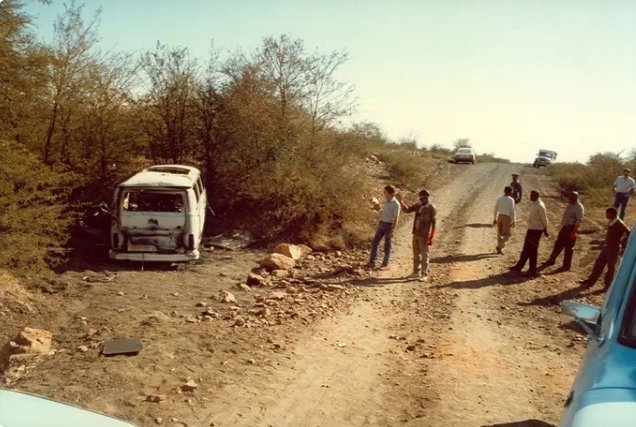
- Mxolisi Malinga recounts how he narrowly escaped being among the 10 young activists killed near the Botswana border in 1986.
- The article examines how apartheid’s security apparatus used deception, informants and the killing of Black activists to enforce its system of power.
- Forty years later, the Khampepe Commission is confronting allegations of political interference that prevented the prosecution of apartheid-era crimes.
I was meant to be the 11th. On 26 June 1986, 10 of my comrades from Mamelodi climbed into a minibus believing they were going into exile to train as freedom fighters, and were executed near the Botswana border.
Forty years later, a judicial commission is hearing that no one in democratic South Africa obstructed the prosecution of the crimes that took them. It is argued here that both events belong to the same grammar of power.
The minibus I did not board
I was 16. That afternoon, hours before the group was due to leave, my mother sent me to buy vegetables at Denneboom Station, near the Masakhane bridge where we were to be collected. When I had finished the errand, I saw the yellow minibus carrying my comrades, driven by Joe Mamasela, the man who had presented himself to us as an operative of uMkhonto weSizwe recruiting young people for military training in Botswana.
I was tempted to abandon the vegetables and join them. A fellow activist persuaded me not to get in. Mamasela promised that he would come back for me. I never saw the 10 again. Three weeks later, on 15 July 1986, I was selected for another group of young activists, to be sent to support comrades in the KwaNdebele homeland against iMbokodo, the vigilante group propped up by the apartheid homeland government.
Mamasela had already infiltrated that operation and arrived in a similar yellow minibus, posing as an operative of uMkhonto weSizwe. I was ill and could not travel. The nine who went were shot, doused with petrol and burnt beyond recognition. Twice the same deception came for me, and twice I lived by accident. I have carried that accident for 40 years.
Nietverdiend: The death that was not deserved
According to the record placed before the Truth and Reconciliation Commission (TRC), the 10, the youngest 14 and the eldest 19, were taken to Nietverdiend, close to the Botswana border. There they were given a drink, injected with sedatives and left in the vehicle, which was driven off an embankment and set alight so that it would look like an accident.
The operation was a joint undertaking of the Northern Transvaal Security Branch and the Special Forces. Brigadier Jack Cronjé later told the Amnesty Committee that there had been no question of arresting or detaining them.
For a decade our families believed that their sons were in exile. They learnt the truth only when the killers applied for amnesty. The Afrikaans place name has since become their collective name: the Nietverdiend Ten. Niet verdiend. Not deserved. The very land pronounced the verdict that the state has refused to pass.
Necropolitics and the zone of nonbeing
Achille Mbembe’s notion of necropolitics names the moment when sovereignty is performed not through the cultivation of life but through the power to determine who may live and who must die. It is a corrective to Michel Foucault’s biopolitics, which presumed a state invested in fostering the life of its population.
Read from the colony, that investment was never universal. Within the colonial matrix of power, black bodies were located in what Frantz Fanon called the zone of nonbeing: bodies that could be killed without the killing registering as a crime. In this vein, my comrades were never constructed as suspects to be charged, tried or even detained.
Cronjé’s admission that arrest was never contemplated is the clearest articulation of the necropolitical logic. The black body under apartheid was reduced to abjection, rendered disposable by the fact of its Blackness and the fact of its political desire.
The askari as a technology of necropower
Necropolitics is most efficient when it does not have to show its own face. The man who came for us was Black. Mamasela was an askari, a figure the security apparatus produced out of captured, turned or recruited black men and deployed into the townships to wear the trust of the community as a mask. This is not incidental to the story; it is its architecture.
The apartheid state instrumentalised the black body against black life, outsourcing the intimacy of betrayal so that white commanders could plan from a distance and later present their crimes before the Amnesty Committee as the pursuit of a political objective. The askari was a technology of necropower. Through him, the township was turned against itself, and the violence that destroyed bodies also destroyed the social fabric of trust, a wound that remains untreated.
Mamasela never applied for amnesty. In June 2026, he was charged with murder, kidnapping, arson and crimes against humanity in connection with the killings of activists of the Congress of South African Students, and the state alleges that he used the same method of deception in Mamelodi. I was in court in Benoni when he appeared.
I never believed I would live to see that day. What I seek from it is an answer to the question that has followed me since Denneboom Station: why he did this to innocent children. The commanders who applied for amnesty, Cronjé among them, received it. The asymmetry is instructive: the black instrument remains criminally exposed while the white architects were absolved through confession.
Necropsy and the work of re-membering
Medicine distinguishes autopsy, literally the act of seeing for oneself and reserved for human beings, from necropsy, the post-mortem examination of animals. I deploy necropsy deliberately, as a hermeneutical lens through which to read how the state handled what remained of my comrades.
Their remains were buried as unknown paupers in an unrecorded and unmarked section of the Winterveld cemetery. Their mothers searched for them for years without the state. Only in 2005 did the National Prosecuting Authority’s Missing Persons Task Team locate nine bodies, burnt so severely that they could not be identified individually through DNA. At their reburial in Mamelodi, 10 coffins carried nine bodies.
The 10th young man, Jeremiah Ntuli, was exhumed only in December 2019, 33 years after his death. What the remains disclose is the ontology of the system that produced them: no names, no records, no individuated identity, only charred matter assigned collectively to a group.
This is the necropsy. It is the reading of black death as the death of a category rather than the death of persons, a continuation of the colonial practice in which the black body was objectified, mutilated and instrumentalised, from the exhibition of Sarah Baartman in Europe to the unmarked paupers’ graves of Winterveld.
To remember, then, is more than to recall. It is to reassemble against the necropsy what the state dismembered: to return to each of the ten a name, a face and a mother, and to refuse the category in which they were buried. Remembering is also a struggle over place.
In Mamelodi, the bronze statue at Solomon Mahlangu Freedom Square has been vandalised and its plaques reportedly stolen for scrap. Heritage that is lost is never regained. A nation that allows its memorials to be sold by weight repeats in bronze what was done to bodies at Winterveld: it reduces memory to matter, and matter to disposal.
A biopolitical autopsy of the democratic state
If necropsy describes what apartheid did to the bodies, a biopolitical autopsy turns the scalpel on the body politic that inherited them. Its question is how the democratic state has valued the dead it received. The Khampepe Commission, established after families of victims went to court, is the theatre in which this autopsy is now being performed, and its findings so far are troubling precisely because nobody accepts responsibility.
The commission does not lack accusers. Former acting National Director of Public Prosecutions Silas Ramaite testified that in November 2004 the then justice minister, Brigitte Mabandla, instructed the National Prosecuting Authority to stop TRC prosecutions, at the very moment arrests were imminent in the case of the 1989 poisoning of Frank Chikane.
Former prosecutions head Vusi Pikoli told the inquiry that he faced pressure from Mabandla and the late police commissioner Jackie Selebi to abandon the cases, and that his tenure ended after he refused. Those accused deny it.
Former president Thabo Mbeki has told the inquiry that the executive did not concern itself with the cases the TRC referred for prosecution, and that the National Prosecuting Authority must carry the failure. Mabandla has denied giving any such instruction.
Ronnie Kasrils has rejected the allegations of political interference. The result is remarkable: sworn accounts of obstruction on one side, categorical denials on the other, and two decades of inaction without an acknowledged author.
Eugene de Kock, the former commander of Vlakplaas whom the public came to know as Prime Evil, told the commission on 26 October that he had been available in prison throughout, could identify the chain of command, and was never asked. De Kock is no reliable moral witness, and his testimony carries his own grievances. Yet his claim exposes the structure.
The system convicted one white operative as the face of apartheid’s evil, absolved others through amnesty, left the black askari for decades outside the courts, and never asked the questions that could have reached the generals and the politicians who gave the instructions.
Within this arrangement, the families of the Mamelodi Ten, and those of us who survived by accident, were asked to carry reconciliation as a burden while others received it as a dispensation.
What the value of Black life demands
Forty years after Nietverdiend, the measure of a democracy is not how eloquently it speaks of reconciliation but how it treats its dead and those who mourn them. A state that cannot say who stopped the prosecutions has not completed its own autopsy.
The commission is due to conclude its work by 18 December. Its report will matter only if it names responsibility, institutional and political, with the same specificity with which the Mamelodi mothers named their sons.
Anything less would confirm that colonialism may have ended, but coloniality did not. The necropolitical order was not dismantled in 1994; it was reorganised into the quieter violence of administrative forgetting. I was meant to be the eleventh. The 10 were killed because they desired freedom. The least that freedom owes them is the truth.
Disclosure Statement: Mxolisi Malinga is a survivor of the events described in this article and was among the young activists recruited for the group later known as the Mamelodi Ten. He has a personal interest in the work of the Khampepe Commission and in the criminal proceedings referred to here. He does not work for, consult, own shares in or receive funding from any company or organisation that would benefit from this article.
Get your news on the go. Click here to follow the Conviction WhatsApp channel.
The opinions expressed in this article are solely those of the author and do not necessarily reflect the views of Conviction.co.za
