


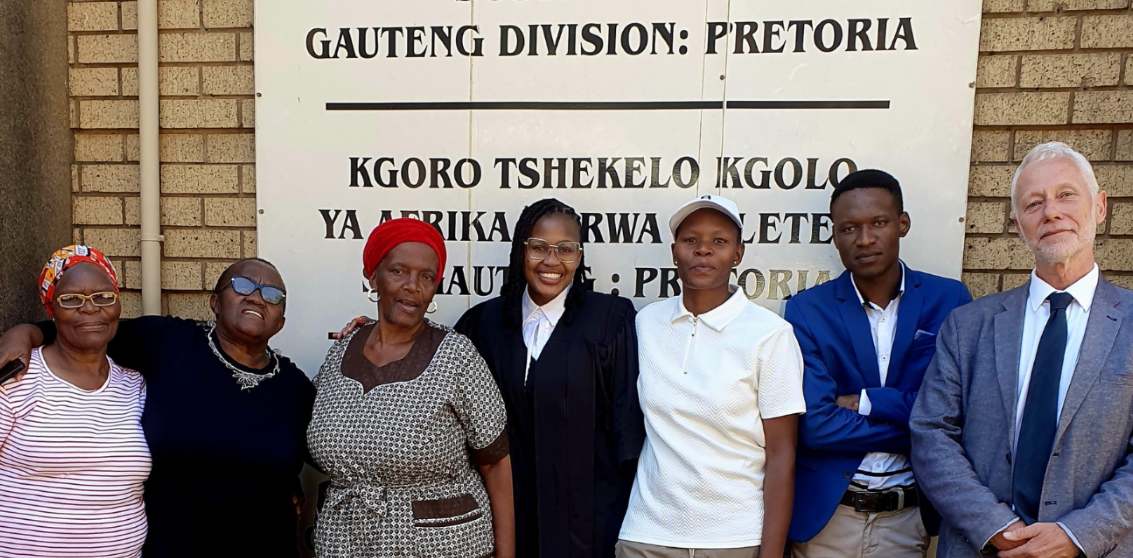
- Henrietta Phakathi agreed to buy a house in Sebokeng from her brother-in-law, Dumisane Gidion Mgcina, back in 2004. She completed her payments in November 2011.
- But despite this, the house stayed registered in Mgcina’s name. The situation escalated into eviction proceedings that Phakathi says threatened to leave her, her children and her grandchildren without a home.
- On 20 October 2026, the High Court in Pretoria ordered the Registrar of Deeds to transfer the property into Phakathi’s name. The court made no order on costs.
A 63-year-old grandmother from Sebokeng has secured a High Court order that will see her home transferred into her name, after a long-running dispute with her brother-in-law over a property she says she bought and paid for more than a decade ago.
Judge Rochelle Francis-Subbiah handed down the order in the High Court in Pretoria on 20 October 2026. The order instructs the Registrar of Deeds to transfer Erf 544027, Zone 3, Sebokeng Township, to Phakathi.
The dispute involved Dumisane Gidion Mgcina, previously known as Dumisane Gidion Mtambo, who was married to Phakathi’s sister, Thandiwe Olga Phakathi. According to Phakathi’s affidavit, her family moved into the house in 2004, but it was never placed in her name, even though she says she completed payment in November 2011.
Phakathi said the disagreement later turned into eviction proceedings and, at one point, she was left without legal representation. She and her family faced the very real possibility of losing their home.
Family agreement to buy the house
According to her affidavit, Phakathi and her family moved into the Sebokeng property in 2004 after reaching an agreement with Mgcina, her brother-in-law. Phakathi’s sister died on 3 October 2013.
Phakathi said the purchase agreement was recorded in an affidavit signed in March 2004. She paid a R10,000 deposit, with the balance to be paid in instalments.
She maintains that she completed the payment on 13 November 2011. A document signed by both parties on that day recorded a payment of R5,000 towards the house, and made clear that this was the final amount owed.
The document was originally written in isiZulu. An English translation, certified by Afrolingo in December 2024, states that Mgcina had received R5,000 from Phakathi for the house in Zone 3, Sebokeng, and that this was the balance of the purchase price.
Phakathi relied on this document to back up her claim that the house was fully paid for. She says Mgcina never succeeded in challenging the document that recorded the final payment.
She argued that the sale was complete, as both parties had agreed on the property and the price, and there were no outstanding conditions to prevent the sale from being finalised. Yet, despite the agreement and all payments, the house remained in Mgcina’s name.
Dispute escalated into eviction proceedings
Phakathi says Mgcina tried to evict her in 2016, but members of the community intervened and stopped the eviction. Mgcina then went to the Sebokeng Magistrates’ Court in 2017, seeking her eviction.
When the matter was heard in September 2018, Phakathi was represented by Legal Aid South Africa. According to her affidavit, the court granted an eviction order against her but suspended it until 30 April 2019, to allow her time to challenge the transfer of the property into Mgcina’s name.
Phakathi said she believed Legal Aid South Africa would take the necessary steps on her behalf. She later found out that no such proceedings had been started, and that she had not been told the organisation would no longer represent her. She says she was left without a lawyer when the eviction order was issued on 12 July 2019.
According to her affidavit, the order was not served on her before 30 July 2019. Covid-19 restrictions on evictions only began on 26 March 2020, several months after the order should have been served, by her account. Mgcina later went back to court to vary the eviction order. The Sebokeng Magistrates’ Court granted this variation on 12 March 2025.
Phakathi says she only learned about these renewed proceedings when she received the papers for the variation application. She then reached out to the Orange Farm Advice Centre, which helped her get assistance from Lawyers for Human Rights.
Lawyers for Human Rights helped her challenge the eviction order and also assisted with the application to have the house transferred to her name.
Phakathi argued that the sale had been completed
In her High Court application, Phakathi asked for an order compelling the Registrar of Deeds to transfer Erf 544027 into her name. Her legal team relied on the principle of a ‘perfecta’ sale, referring to a Supreme Court of Appeal case, SouthernEra Resources Ltd v Farndell NO.
That decision explained that a sale is ‘perfecta’ when both parties agree on the property and the price, and any conditions have been fulfilled. Phakathi argued that she had done everything required of her by paying the full purchase price, and there were no conditions left to be met.
She maintained that Mgcina should not be able to rely on the fact that the transfer was never registered, when she had done her part and deserved to have the house in her name. The Registrar of Deeds was the first respondent in her application, as she was asking the deeds office to carry out the transfer. Mgcina was named as the second respondent. She did not seek any costs against the Registrar of Deeds.
High Court referred the ownership dispute for oral evidence
The case first came before the High Court on 28 January 2026, when Judge Sulet Potterill referred it for oral evidence to establish who truly owned the house. This meant the matter would be examined through live testimony, rather than just on the documents presented by the parties.
Phakathi’s legal team indicated, in a practice note, that she intended to call four witnesses, including herself, to give evidence about the ownership. Although the court did not require witness statements for that hearing, Phakathi and three others prepared statements that could be given to the court if needed.
The practice note emphasised that witness statements do not automatically replace oral evidence in High Court civil proceedings. Whether statements have to be filed or exchanged depends on the court’s rules and the judge’s discretion.
The application was set down for an unopposed hearing on 20 October 2026. The practice note records that the notice of set-down was personally served on the Registrar of Deeds on 4 August 2026 and on Mgcina on 12 August 2026.
The court was asked to grant the relief set out in the notice of motion and draft order. It is unclear whether all four witnesses ended up testifying or how the earlier referral for oral evidence was handled at the final hearing.
Family faced the prospect of homelessness
According to Phakathi, the dispute put her entire household at risk of losing their home. Her founding affidavit listed her daughter, Bongekile Phakathi; her sons, David Nhlanhla Phakathi and Mathews Phakathi; and her grandchildren, Lungisane (16) and Lungelo (14), as family members living in the house.
She said the family depended on social grants and she could not afford a private lawyer. The applicant’s practice note warned that if the application failed and the eviction went ahead, Phakathi and her family would be left homeless.
Lawyers for Human Rights takes up the case
Lawyers for Human Rights (LHR) brought the High Court application seeking an order directing the Registrar of Deeds to transfer the title deed into Phakathi’s name. The organisation became involved after Phakathi approached the Orange Farm Human Rights Advice Office for assistance following renewed eviction proceedings.
David Dickinson, LHR’s case attorney, acknowledged the people and organisations who supported the family throughout the case. “This success was made possible by many people. Thanks go to Mamy Tladi who rallied the community in support of the Phakathi family; Advocate Malebogo Mashishi of Circle Chambers who represented Mme Phakathi pro bono in the High Court; the Orange Farm Human Rights Advice Office for their assistance; and to all those at Lawyers for Human Rights who helped on the case.”
Louise du Plessis, LHR’s Land, Housing and Property Programme head, said the case highlighted wider problems with property ownership and transfers in townships. “This case illustrates just some aspects of the chaos that characterises township housing,” Du Plessis said.
“The title deeds system and the cost of conveyancing are generating an epidemic of property disputes. A complete re-think of property ownership and transfer, appropriate to the realities of the majority of South Africans, is urgently needed.”
High Court orders transfer of the property
On 20 October 2026, the High Court ordered the Registrar of Deeds to transfer the title of Erf 544027, Zone 3, Sebokeng Township, into Phakathi’s name. The order also said there would be no order as to costs.
The court directs the Deeds Office to carry out the transfer Phakathi requested. It does not give detailed reasons for the decision or make findings on every disputed point in her affidavit.
Get your news on the go. Click here to follow the Conviction WhatsApp channel.

2 Comments
Good day. Enjoying reading the cases. Please do not stop it.
Thank you.