


- The genocide claim fails to meet the legal threshold of specific intent required under the Genocide Convention.
- Farm attacks and rural insecurity remain serious concerns, but available evidence does not establish a state-sponsored campaign to destroy Afrikaners.
- Washington’s decision to terminate South Africa’s AGOA trade benefits threatens exporters, jobs and agricultural communities already caught in the diplomatic fallout.
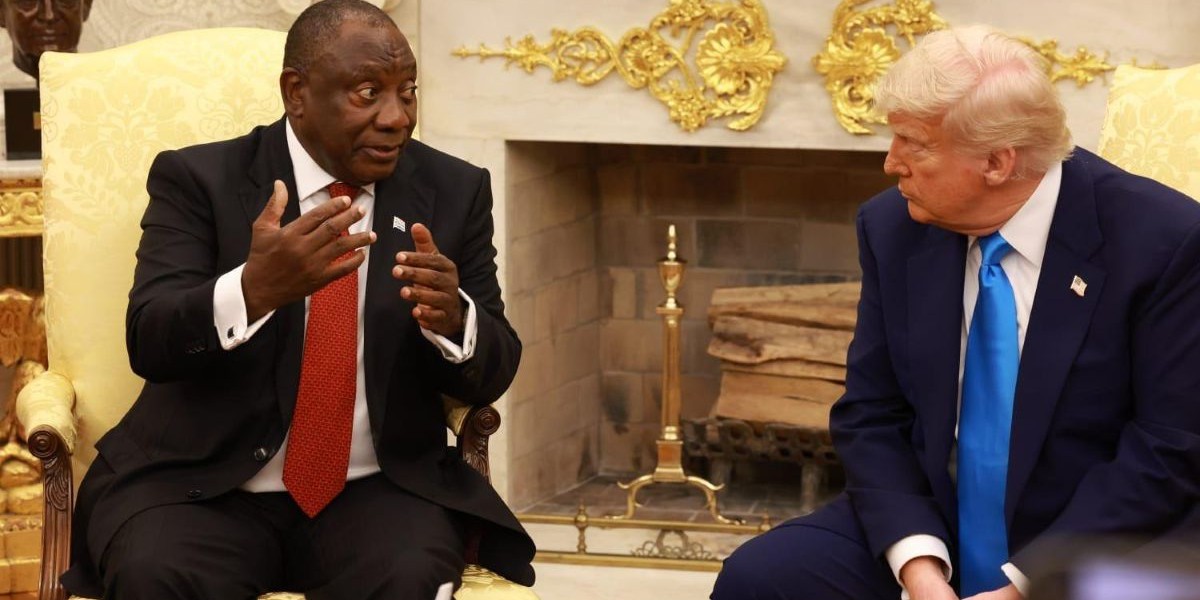
Pretoria’s relationship with Washington, D.C. has deteriorated from diplomatic disagreement into material consequence. On 2 November, the Office of the United States Trade Representative announced that President Donald Trump had notified the US Congress and Pretoria of his intention to terminate South Africa’s eligibility for the African Growth and Opportunity Act (AGOA) starting 1 January 2027.
Washington cites barriers to American trade and investment, corruption, and other practices it regards as threatening US national security and foreign policy interests. This decision follows a year of extraordinary tension in bilateral relations.
The core disputes are not new: South Africa’s foreign policy, BRICS Plus membership, including its case against Israel at the International Court of Justice; its relations with nations Washington regards as adversaries; land reform; race-conscious economic policy; and trade disagreements.
However, another narrative has increasingly driven this rupture: the claim that White South Africans, and Afrikaners in particular, are victims of genocide. The White House’s February 2025 executive order accused South Africa of human rights violations and established a policy to resettle Afrikaners allegedly escaping “government-sponsored race-based discrimination”. In fiscal year 2026, US refugee admissions were overwhelmingly dominated by South Africans, and the fiscal year 2027 ceiling of 17,500 refugees is again set to be allocated primarily to Afrikaners.
Irony in diplomatic decline
There is an uncomfortable irony that underlines this diplomatic decline. The same Trump administration that established a refugee pathway for Afrikaners is now moving to remove trade preferences from the very country in which most Afrikaners live.
The fallout will not align neatly along racial or political lines; while it will be felt across the broader South African economy, the effect will predominantly be in export-oriented sectors. As AGOA’s largest beneficiary, South African exporters of automotive components, fruit, and wine face significant vulnerability to the loss of preferential market access and the elimination of import taxes.
Agricultural producers have warned of squeezed margins and job losses, particularly in orchards planted specifically for export to the US. Consequently, members of the very farming communities central to Washington’s narrative may bear the direct economic cost of this geopolitical rift.
The ‘white genocide’ narrative in political symbols
This narrative has also been projected through powerful political symbols. In September, approximately 3,000 white crosses were erected on the National Mall in Washington, each with the name of an individual reportedly killed in a South African farm attack since 1990. The display aimed to place farm violence and Afrikaner safety on the American political agenda.
Yet even civil society groups like AfriForum and the broader Solidarity Movement have clarified that their experience does not align with a large-scale, state-driven “genocide”. Crucial debates exist around violent crime in agricultural communities, the vulnerability of rural folk, workers and landowners alike, inadequate rural policing, and whether specific attacks are motivated by racial hatred.
However, these issues are distinct from a far weightier claim: is genocide occurring in South Africa? When this assertion gained prominent international traction in 2025, I stated to FactCheck.org that “describing farm killings as genocide is a gross mischaracterization”.
Al Jazeera subsequently quoted my assessment that there is “no credible evidence” that white farmers are being systematically targeted in a campaign of genocide. That assessment remains firm. Yet, as US–South Africa relations deteriorate, simply reiterating this conclusion is insufficient. If genocide has become a core political framework through which South Africa is evaluated abroad, the claim must be subjected to standard evidentiary and legal scrutiny.
Legal standards for genocide
Begin with the legal framework. Article II of the 1948 Genocide Convention defines genocide through five specific acts, which include killing and causing serious bodily or mental harm, committed “with intent to destroy, in whole or in part, a national, ethnical, racial or religious group, as such”. It hinges on that specific intent (dolus specialis).
Prohibited acts must be accompanied by the explicit intent to decimate the protected group, in whole or in substantial part. The International Court of Justice has established that where genocidal intent is inferred from a pattern of conduct, it must be the only reasonable inference available. High crime rates do not inherently establish genocidal intent, systematic discrimination may constitute persecution, and widespread civilian attacks may amount to crimes against humanity—yet none of these automatically constitutes genocide.
Empirical record and data gaps
Now examine the empirical record. Farm murders occur, and many are brutal. While law enforcement does not routinely record victims by race, a structural data gap, official police disaggregations demonstrate the nuance: out of six farm murders recorded between January and March 2025, five victims were Black and one was White.
“Farm murder victim,” “white farmer,” and “Afrikaner” are non-identical analytical categories. These fatalities exist within a broader national murder crisis that impacts poorer communities most heavily. From the 2003 official inquiry into farm attacks to contemporary data, evidence consistently identifies robbery and financial gain as primary motives, with negligible cases indicating political design.
The geographic isolation of farms creates criminal opportunity amidst broader socioeconomic inequality; it does not, on its own, constitute evidence of a state-sponsored plot to eradicate a racial group.
Scrutinising the genocide thesis
Proponents of the genocide thesis point beyond body counts, citing the singing of “Kill the Boer”, the Expropriation Act 13 of 2024, race-conscious economic legislation, and rural policing deficits. These claims warrant serious scrutiny rather than dismissive contempt.
Tested against evidence, a political chant—regardless of its offensive nature—does not constitute an operational campaign. Government reporting confirmed in May 2025 that zero land had been expropriated under the new Act. Challenges in rural policing reflect systemic state capacity failures similar to those in township areas; institutional neglect does not equal genocidal design.
Neither individually nor collectively do these factors prove an intent to destroy Afrikaners. Notably, Washington’s own 2025 executive order alleges “government-sponsored race-based discrimination,” not genocide. Similarly, its November 2026 AGOA notice cites trade barriers, corruption, and strategic interests—not mass atrocities. Even within Washington’s policy instruments, the legal charge of genocide is absent.
Memorials and evidentiary disconnects
The memorial display highlights this evidentiary disconnect. Organisers acknowledged that the Lex Libertas registry commemorates all victims of farm violence, rather than exclusively white victims. Honouring every victim of rural violence is necessary and valid, yet deaths spanning across racial demographics cannot simultaneously serve as proof of a targeted racial destruction of White South Africans. The memorial captures a crisis of rural crime; it cannot bear the weight of a genocide claim.
International developments further complicate the narrative. Reuters reported in April that at least four resettled South Africans had already returned home. While individual returns stem from complex personal factors and do not settle broader questions of societal discrimination, they challenge claims that South Africa presents an unviable environment for targeted groups.
The same investigative discipline applied to rural crime must apply elsewhere: when twelve women were murdered across Ekurhuleni between July and September 2026, police task teams investigated potential links while explicitly cautioning against hasty generalisations. This reflects necessary analytical rigour—establishing facts, motives, and systematic connections before assigning categorical definitions.
Justice, suffering, and legal precision
The same standard must apply to agricultural communities. A murdered farmer does not need to be designated a victim of genocide for their death to demand justice, nor does a murdered farmworker need to fit an international political narrative for their killer to be prosecuted. Grief should not depend on hyperbolic terminology. Genocide is not a metric of suffering; it is a high legal charge requiring strict evidentiary proof. Those who deploy the charge bear the burden of proving it.
This distinction is vital as rhetoric shifts into material consequence. South Africa’s diplomatic relations with the United States are now deteriorating, directly threatening trade, investment, and employment. Exporters in agriculture, including the citrus, fruit, and wine industries, are calculating squeezed margins and job losses following the decision to end AGOA preferences as of January 2027. Ironically, the very farming communities frequently invoked in international political narratives may carry the economic burden of this bilateral fallout.
Policy contradictions and the importance of accurate diagnosis
This outcome creates a striking policy contradiction: Afrikaners are offered refugee status by Washington to escape perceived racial persecution, while concurrent US economic measures destabilise the agricultural economy supporting those who remain—Afrikaners and Black South Africans alike.
Pointing this out does not minimise rural violence. It underscores why accurate diagnosis is critical: flawed diagnoses lead to destructive policy. South Africa faces severe violent crime, rural insecurity, and governance failures requiring urgent state intervention. Mislabeling these structural crises as genocide without evidence distorts the problem and generates real-world economic harm.
Get your news on the go. Click here to follow the Conviction WhatsApp channel.
The opinions expressed in this article are solely those of the author and do not necessarily reflect the views of Conviction.co.za
